What?
There is currently intense debate about immigration in the UK. We will examine that directly in future articles.
But before arguing about causes or solutions, we need to answer a simpler question: how many people actually live in the UK, and how fast has that number changed?
Without context, it is easy to misunderstand the scale.
Facts
The UK today
The Office for National Statistics (ONS) estimates that in mid 2025 the UK population stood at 69,487,000. It is expected to pass 70 million during 2026.
That figure represents the number of people living in the UK, not visiting. In addition, Government statistics show 135.9 million passenger arrivals in the year ending September 2025. Of those arrivals, 44% were non-British nationals that included those arriving for work, study and family reasons.
The overall volume of movement into and out of the UK each year is significant relative to the total population.
The UK in the past
Now let’s step back and understand the past 150 years.
In 1876, when the American Wild West was still unfolding and the Battle of Little Bighorn was fought, the UK population was 33.2 million.
In 1901, the year Queen Victoria died, it was 41.5 million.
In 1926, when A. A. Milne published Winnie the Pooh, it was 45.2 million.
In 1951, the year Libya became the first country to gain independence through the United Nations, the UK population stood at 50.3 million.
In 1976, the year of the first commercial Concorde flight, it was 56.2 million.
In 2001, when So Solid Crew released “21 Seconds”, it was 59.1 million.
Today it is approaching 70 million.
In 150 years, the population has more than doubled.
In just the last 75 years, within the lifetime of many people still living, it has grown by almost 20 million.
Around 10 million of that increase has happened in the past 25 years alone.
Why It Matters
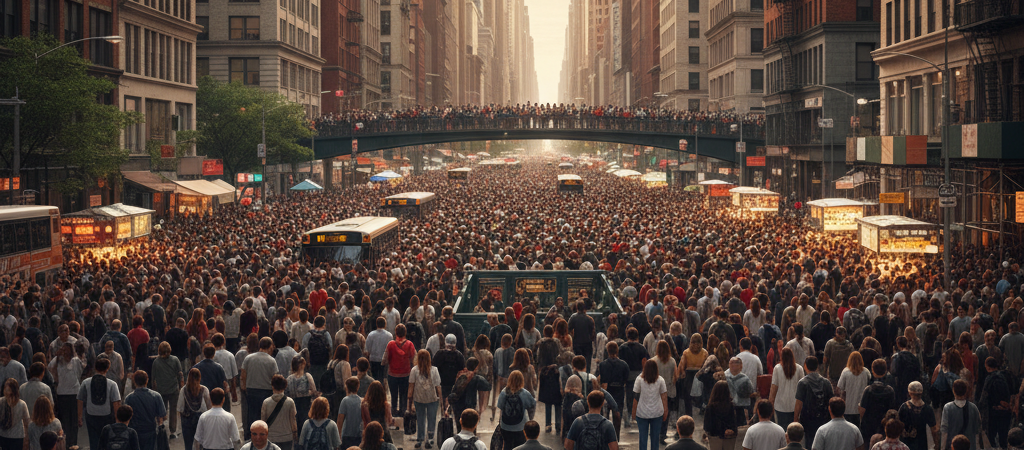
Ten million people is not an abstract number.
Birmingham has a population of about 1.1 million. The UK has added the equivalent of roughly nine Birminghams in the last 25 years. Nine.
But we haven’t built nine new Birminghams.
Population growth affects:
- Housing supply
- GP appointments
- School places
- Transport capacity
- Public services
- Energy and infrastructure
Whether you see growth as positive, negative, or necessary, the scale is real. The key question is not whether population has changed. It clearly has. The question is whether infrastructure, planning, and policy have kept pace.
Myth Buster
You will often hear that the UK, or even the world, is “running out of people” and that we simply do not have enough.
The UK population is about to exceed 70 million, over 10 million higher than just 25 years ago. That is not demographic collapse.
Globally, the world population has more than tripled since 1950. It now stands at over 8.25 billion. That is 8,250,000,000 people. Roughly the equivalent of 5,000 Birminghams.
Some countries face ageing populations. Some face declining birth rates. Those are real policy challenges but the idea that the UK is suffering from a shortage of people is not supported by the basic numbers.
Whatever position you take on immigration or economic growth, the UK today is more populous than at any point in its history.
The debate is not whether we have enough people. It is what we are doing with the ones we have, and the ones still to come.
Sources
As always, sources matter. Here are the relevant ones:
- Office for National Statistics (ONS), released 27 November 2025, ONS website, Provisional population estimate for the UK: mid-2025
- Office for National Statistics (ONS), Census 2021: Towns and cities, characteristics of built-up areas, England and Wales: Census 2021
- UK Government, Immigration System Statistics Year Ending September 2025: How many people come to the UK each year?